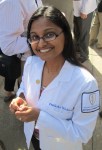
Alexandra Tee
This is a finalist in the 2016 STFM Student Blog Competition.
For my eighth grade graduation my aunt gave me a card that read, “It’s the journey, not the destination.” I loved it. I wrote it on other people’s cards. I think it was my senior year yearbook quotation. It made so much sense to me.
Last year, as a bright-eyed second-year medical student chugging all the family medicine lemonade at the AAFP National Conference, I attended a session about caring for communities that argued, “It’s not the destination, or the journey. It’s the direction.”
All these years of journeying, and I was focused on the wrong cliché?
When I step back and think about direction, I notice a certain pattern: humans travel in circles. If anyone told 9-year-old me that there would be signs on the road warning, “Don’t Pokemon GO and Drive,” I would be ecstatic. But in 2016, the necessity of such signs stirs up a cocktail of disappointment, amusement, and irony. Turn on the news, scroll through the latest hashtags, or read the paper (if you know where to get one)—history still seems to repeat itself. Therefore, when prompted to answer where I see family medicine in 10 years, it made sense for me to look 10 years back. In 2006, an AAFP editorial written by Dr Sanford J. Brown, “Reinventing Family Medicine,” opens with, “Our specialty is ailing.”
After outlining the defining skill sets of family medicine: practice management, wellness medicine, information technology, home visits, family dynamics, and community medicine, Dr Brown concludes with:
“The fight for privileges to do procedures saps our energies and is one that we will eventually lose, not only because specialists are better trained to do them, but because in this day of consumer-driven health care, our patients will select the doctors with the most experience and best track records to do their colonoscopies, colposcopies, cardiac stress tests, C-sections, hernia repairs, and critical care. Perhaps no other specialty trains its residents to do so many things they will never use in practice, while spending so little time training them to do what most of them will wind up doing—clinic medicine.
To maintain the dynamism of our specialty, we must define ourselves by what we can do better than everyone else, not by what everyone else is doing.”1
I agree with Dr Brown in that we define ourselves by what we can do. Furthermore, I believe we must define ourselves by who we want to be for our patients. As family physicians we are advocates for our patients throughout their lives, through specialty visits, insurance changes, and health care reforms. We practice clinic medicine as active members in our communities. Contrary to Dr Brown, I believe that what everyone else is doing is extremely important to us. In the growing age of inter-professional health care teams, care coordination is becoming increasingly crucial in providing quality care for patients. As a future family physician, I want to voice my patient’s concerns and best interests in the medical jumble of specialties, insurance policies, and health care system red tape. I am inspired by family physicians involved in policy and practice model transformations, and I hope that more physicians-in-training recognize the role family medicine plays in the delivery of care. We assert ourselves in the processes that shape our patients’ experiences because we stick with patients from beginning to end. As patient advocates and community leaders, we must lead health care into a direction that improves health care for everyone.
Everything in my journey through medicine is the hardest thing I’ve ever done. The MCAT was the hardest test I’d taken, that is, before USMLE Step 1. A full history and physical OSCE was the hardest thing I’d ever done, until I had to convince a veteran who had avoided hospitals for 40 years and lost 50 pounds in a matter of months that he needed to finish his GoLYTELY so we could tell him he had end stage colorectal cancer. Unlike many decisions in my medical journey, choosing family medicine was not hard. However, like all my previous hardest-things-ever-done, figuring out the direction of family medicine will be a challenge. What direction is family medicine heading towards?
I believe family medicine is directed towards becoming leaders for change. As physicians-in-training, we have worked countless hours and made too many sacrifices to work in a sick care system that we are not confident provides the best quality care for our patients. Family medicine physicians play the ultimate advocate for our patients, their families, and our communities. We listen to the struggles of patients fighting to overcome health care barriers. In order to empower our patients, we must engage in leadership roles and national discussions. By doing so, we will be able to create change in the systems that often fail our most vulnerable patient populations. Ten years from now, family physicians will continue to grow as agents of change, directing our health care system to provide comprehensive, cost-effective, patient-centered care. Knowing who family medicine physicians are for their patients and communities, I know I will choose the journey of family medicine in any direction. I still believe in the journey, and I am hopeful in the direction that family medicine is moving towards.
Reference
- Brown S. Reinventing family medicine. Fam Pract Manage 2006 Apr;13(4):17-20.