Office Stories

I find office spaces interesting. The piles (or lack of piles), photos, and mementos share a glimpse of the personality of the people, work styles, and things individuals value.

Stacy Brungardt, CAE STFM Executive Director

A little more than a year ago, STFM revamped our headquarters office. In our 4,000 square-foot corner of the 5th floor of the AAFP building, STFM staff publishes the journal, plans our conferences, and runs the more than 40 initiatives of the Society. We wanted the space to be both inspiring, practical, and reflect the core values of STFM. We squeezed a lot from our lean redecorating budget and started by getting rid of stuff—old office furniture and unused items you collect over time that clutter the mind. That felt good.
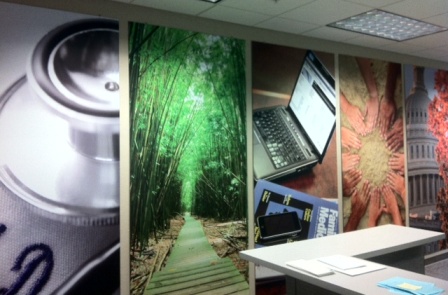
Now when you walk in our offices, the first thing you’ll likely notice are five 8-foot color images of a stethoscope and lab coat, tree-lined arched path, a journal/smart phone, a circle of hands, and a capital building. These images depict the Society’s core priorities of workforce development, professional and leadership development, scholarship and innovation, professional relationships, and policy advocacy. They’ve added a splash of color and meaning to our space. This wall used to display all our past presidents’ photos. We took those down and put them in a nice scrapbook. Admittedly, they were interesting to see and are missed by some of our staff. At the same time, staff agreed that the message we want to communicate to one another and visitors is that we are here to serve and celebrate all our members, not just those who move to STFM’s highest ranks.

As part of the revamp, we took a storage area and interior office and created a conference room as a space to come together for meetings or just to build relationships by eating together at lunch or special occasions.

We painted several walls nutmeg (think nice burnt orange), which added warmth to our sterile walls. A little table and lamp provide an extra homey touch. Around the top of all our walls we have black and white framed and matted pictures. These are pictures staff provided of images that inspire them. The pictures show children and grandchildren, landscapes and beaches, and people and places that matter to each of us.
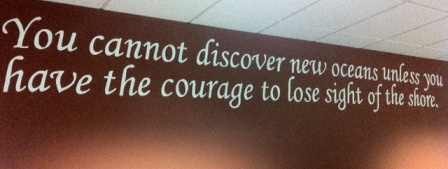
Staff selected a quote for the top of one wall that says, “You can’t discover new oceans unless you have the courage to lose sight of the shore.” This reminds us that taking risks is a necessary part of our business, and the success of the Society depends on it.

On two walls we created a montage of members, photos and conference locations. Highlighting another wall are images that spell out the letters STFM in photos, a thoughtful gift to staff from past President Terry Steyer.
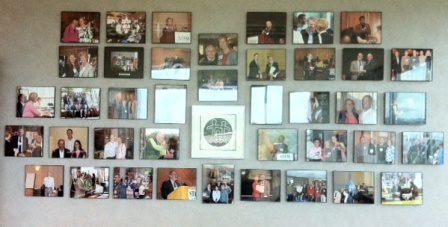
My favorite part of our space is my office wall with member photos of individuals who have had an impact on my career with STFM. My favorite shot is a photo of Lucy Candib and Peter Coggan dancing on stage when Lucy accepted the 2010 F. Marian Bishop Award. That moment captured so much of what I love about STFM – the joy and celebration of our members who make a difference in the world every day.

That’s our story. Does your space reflect the values you want to communicate? Let us know; we’d like to share your story.

The New Resident Work Hours—Are We Training Shift Workers?

Joseph Scherger, MD, MPH

Throughout my career, I have been in favor of restrictions on resident work hours. After watching how surgery residents worked in the 1970s, I wanted none

of that “prison sentence.” After choosing family medicine, I found a program with “civilized” work hours. I do not think much learning happens after working 80 hours in a week, and patients do get harmed by residents who are too fatigued to care or use good judgment.

I embraced the 2003 ACGME resident work hour restrictions since they had flexibility but limited the on-duty time to 80 hours a week and guaranteed some days off each month. Residents could still sit with patients who were going through a long labor and delivery process or who were in end-of-life care. These long experiences are some of the most memorable for residents and do not occur too often to cause chronic fatigue. They showed the resident how well they can work under occasional extreme circumstances, a skill that would be valuable in a crisis.

The 2011 ACGME work hour restrictions are much more specific and prohibit the time for any “work shift.” First-year residents may no longer work on any given day more than 16 hours. That means that if the resident is with a woman in labor or at the bedside of a critically ill patient they must end their work and turn the care over to another resident. Second- and third-year residents must do the same after 24 hours and must be able to have a “strategic nap” after 16 hours. Is this the continuity of care of a family physician? No family physician in practice would ever consider such an abandonment of their patient! This is how emergency room physicians work, and I wonder if these new work restrictions will transform family medicine into shift workers.

There is evidence that we become less effective in our clinical judgment after 12 hours of continuous work and certainly after 16 hours. With that being so, we should train for teamwork where another physician joins us in the care of the patients after we become less effective. That would reinforce that we are not superman and should ask for help but would not take us away from the very situations where we may be doing the most good and are having a great learning experience.

I hope our leaders in the ACGME will make an effort to revise the resident work restrictions again to allow for both continuity of care and teamwork, so we can balance both clinical experience and patient safety.

The Scope of Family Medicine Is Expanding

Joseph Scherger, MD, MPH

Many educators are lamenting today that the scope of family medicine is shrinking.

They refer to fewer family physicians working in hospitals and doing procedures. Warren Newton, MD, MPH, chair of the American Board of Family Medicine, recently sent out a letter expressing this concern. Such a grave outlook is dangerous to our specialty at a time when we are struggling to motivate medical students to go in to family medicine.

I think just the opposite. Family medicine today is more complex and expansive in some ways than ever before. Sure, fewer of us are delivering babies and doing hospital medicine, but family medicine is first and foremost a primary care specialty. Primary care is expanding and becoming far more complex in this new age of medical homes and the advanced use of information systems.

The Willard Report that set the stage for the transition from general practice to family medicine called for the creation of a new primary physician. That doctor would be the personal physician to individuals and their families. It is that personal physician role that is the essence of our specialty. New models of primary care, from concierge medicine to team-oriented medical homes to populations of patients, are deeply complex and expansive.

What do I mean? Prevention became part of primary care in the 1970s and continues to expand.  Primary prevention includes all efforts to prevent disease, and since lifestyle causes 50% or more of disease, motivational counseling toward lifestyle change is a new and vital part of being a personal physician. Secondary prevention is the early detection of disease and knowing and applying all aspects of the US Preventive Services Task Force recommendations requires good information systems and skills. Tertiary prevention is the prevention of complications of chronic disease and is far more complex than when I finished residency 30 years ago.

Chronic illness drives about 75% of all health care costs so effective management of these problems is vital to our health care system. The routine visit of a type 2 diabetic patient is far more complex than before and requires much more time. Acute problems are still a major part of family medicine and if we are available to our patients online, we can manage or coordinate care much more efficiently. Relationship-centered care calls on us to know our patients well and provide the counseling services our patients need to deal with what life brings to them, attending to the biopsychosocial and spiritual dimensions of illness.

So, let’s stop this talk about the scope of practice of family medicine shrinking. I am grateful to have more time to take a deep dive with my patients and be their personal physician with much greater complexity and effectiveness than ever before. Let’s train our residents to do the same and show off this rewarding specialty to our students. What can be better than being a family physician?