Category Archives: Education

Looking Back to Look Forward: In Support of the STFM Foundation

by Peter Coggan, MD

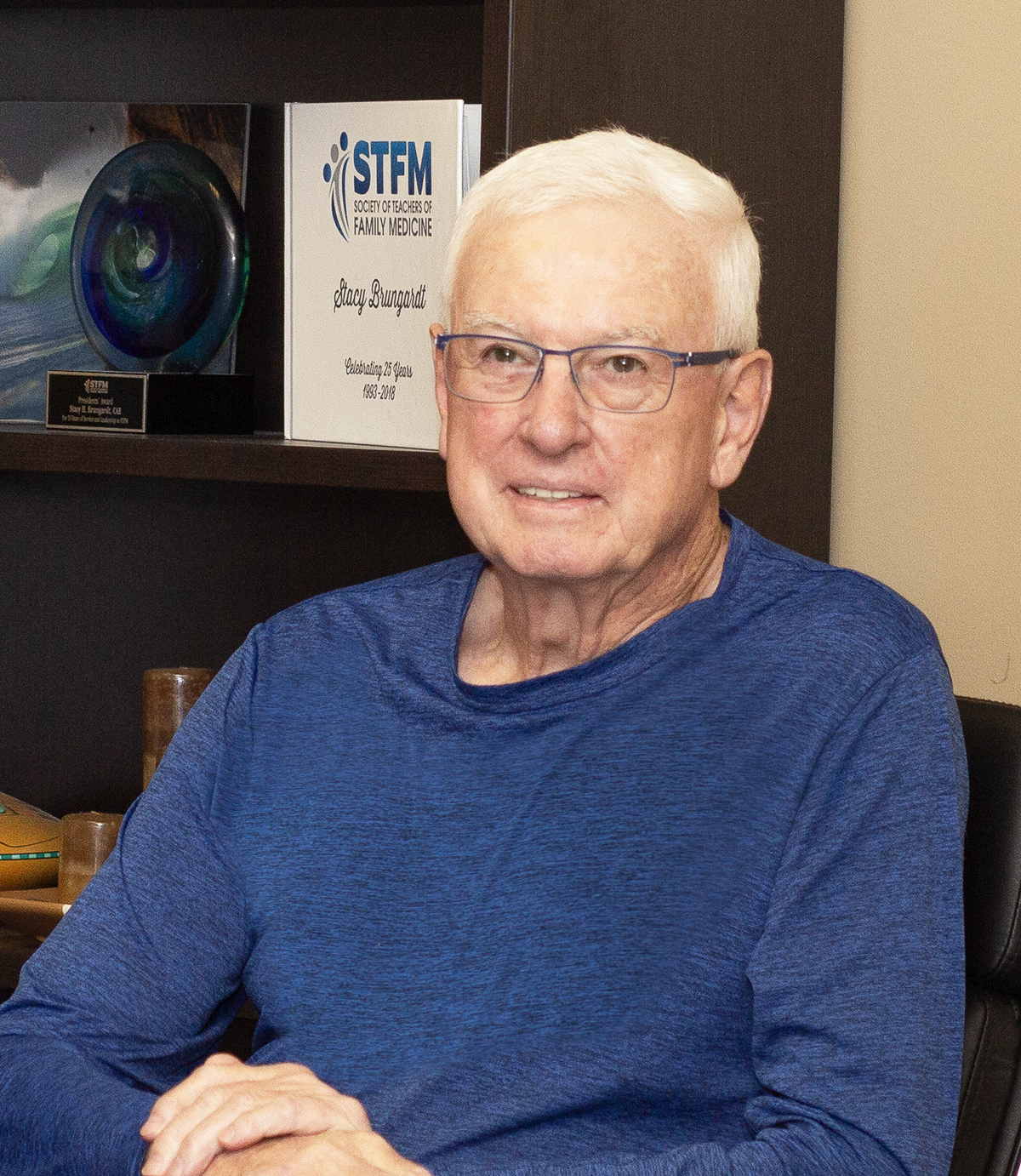
Peter Coggan, MD, pictured in fall 2023 at STFM headquarters in Leawood, KS.

Editors Note: The Winter 2023 STFM Blog features guest author and long-time STFM member Peter Coggan, MD, on the importance of preserving the sanctity of the physician-patient relationship through financial support of the STFM Foundation.

At the beginning of my career, looking back on it, like many faculty in the 1970s I was recruited out of private practice where I had enjoyed teaching medical students and residents rotating through my office. I approached my new role as full-time faculty with enthusiasm and rapidly realized that I was ill-prepared for it.

My first STFM meeting in 1979 was a revelation that was both exhilarating and intimidating. The plethora of workshops, presentations, and other activities were exactly what I needed, and, equally important, were the casual hallway conversations with other attendees – all of us struggling with many of the same questions. These were conversations in which shared problems were openly discussed, mistakes freely disclosed, and solutions offered but, perhaps most important of all, these were conversations that grew into mentorships and friendships over the years. I had found my academic home and in it a place that, at the heart of it all, would help me to realize my desire to teach the physicians of the future to provide better care and in doing so, become a better physician myself.

The middle of my career, as I look back on it, was marked by an increasing involvement with STFM – an almost unbroken attendance for 35 years at the national meeting – the privilege of running the Pre-Doc meeting (now retitled as the Conference on Medical Student Education), participating in multiple presentations, serving on STFM committees and the STFM Board of Directors (twice, in fact) and, with each experience, learning skills that were invaluable to my career.

In the autumn of my career, as I look back on it, the urging of Roger Sherwood (our then Executive Director), led me to the Foundation Board and the discovery of a wonderful opportunity to pay back for all that I had received through my membership in STFM through the Foundation’s many programs and initiatives.

Today in my dotage, as I look back on it, there is the grateful recognition that I could not have had the career opportunities that came my way without STFM. It is also gratifying to reflect on the many members I have met along the way who have become leaders in our field, with successful careers of their own as they carry the STFM mission forward.  Their innovations in presentations and projects first aired in the early and middle years of my STFM membership have, in many instances, joined the mainstream in teaching and patient care. And our specialty is much the better for it.

As for tomorrow, as I look forward to it, I close this brief homily. I hope you will forgive me for a reflection born of, as William Wordsworth expresses it “the inward eye that is the bliss of solitude”. Excellence in the care of patients and their families is the goal we all share in our teaching and our personal practice. Within that, and central to it, is the importance of the doctor-patient relationship, which is a core value for STFM, its Foundation, and the specialty of family medicine. As the practice of medicine continues to evolve as it must, new ways to identify and treat medical problems and ways to communicate with our patients will become everyday tools and, in this context, I look with confidence to STFM to ensure the doctor-patient relationship is preserved. After all, that relationship is central to the practice of medicine, the most intimate and personal of the professions, and, should it not survive, our profession will fade into obscurity.

That, as I look forward to, is the context in which I hope you will join me in supporting the STFM Foundation. My motivation, at the heart of it all, is my wish for you to teach the physicians of the future to provide better care and in doing so, become a better physician yourself, enhancing and preserving that essential quality of our profession – the sanctity of the physician-patient relationship.

We invite you to join Dr Coggan in ensuring future generations of family medicine educators continue to have access to the invaluable STFM resources. Just as the personal and professional contributions you’ve made to family medicine education have undoubtedly had a profound impact on those you’ve met, mentored, led, and collaborated with throughout your journey, a bequest to the STFM Foundation Endowment ensures that impact for generations to come. Your contribution directly supports STFM initiatives and programming like scholarship opportunities for underrepresented in medicine (URM) learners and educators, research grants, conferences, curricula, and more. The STFM Foundation Trustees created the Foundation Endowment to provide a mechanism for passionate family medicine educators to contribute to the long-term success of the STFM Foundation and STFM as a whole.

Improving the Clerkship Learning Environment for Introverts

“There are strengths and weaknesses associated with introverted traits and with extroverted traits. Extroverts thrive in social situations, can rapidly form relationships with team members, and are comfortable with spontaneous brainstorming, thinking aloud and offering ideas quickly and assertively. Introverts’ strengths include thoughtfulness, listening, humility, and forming deep connections. They process internally, share fully formulated thoughts, and prefer to avoid bringing attention to themselves.”

—Kendall Jones, University of Washington School of Medicine

by Kendall Jones, University of Washington School of Medicine

When I meet a patient in clinic, I am in my comfort zone, focused on connecting and creatively problem-solving. But when I leave the exam room, I feel overwhelmed and misunderstood—my mind races as I struggle to communicate my thinking. Patient care settings can be chaotic and the requirement to perform on-the-spot for evaluators frequently does not create a learning environment that accommodates introverts.

While improving the learning environment for students from all backgrounds is an ongoing effort in medical education, I haven’t heard discussion about the experience of introverted students in clinical rotations. The current model of clinical phase medical education frequently does not create a safe learning environment for introverted students. For me, this has contributed to a negative cycle of anxiety and underperforming. Patients appreciate my careful listening and thoughtful responses. But in a rushed clinic, I feel any information I can share is treated as redundant. As I present, I feel concerned about taking up too much space despite the importance of this presentation for my grade. Preceptors observe my hesitancy and lack of self-assuredness and interpret it as failure. But confidently voicing my thinking process is much more difficult “on stage” than in a real-life patient-care setting. Awful feelings related to these experiences day-in and day-out are a significant challenge: I observe myself reaching burnout faster than other classmates, and I worry that I don’t have the energy-levels, constitution, and extroversion required to succeed in medical school and residency. However, I found that research and commentaries validate my feelings and experiences. I am not alone.

Over the course of the last three decades, the Center for Research in Medical Education and Health Care has investigated medical student personality and personal characteristics and correlations with student success and patient care. In 2004, they found that greater self-esteem and higher scores of extroversion could predict global ratings of clinical competence in core clerkships in medical school. Systematic reviews support the finding that introverted students tend towards poorer evaluations related to interpersonal behavior during clerkship rotations. 1 In 2005, Davis and Banken identified significant positive correlation of extrovert traits with clinical performance in an OBGYN clerkship but no correlation with performance on the standardized subject exam, consistent with other studies finding lack of correlation between more subjective clinical evaluations and more objective measures of clinical knowledge. They thus questioned, as have others before, whether clinical evaluations should be included in the overall evaluation score or if they should be labeled ‘interpersonal skills’ rather than ‘clinical evaluation’ to more accurately describe what the evaluation reflects. 2 Surveying nearly 3,000 students who completed core clerkships, Lee et al. found that more reserved students were more likely to report lower grades while more assertive students received lower grades less frequently. 3 A possible mediator for these findings is extroversion. This allows students to demonstrate their enthusiasm and knowledge to their evaluators which can improve their subjective grade. Another explanation is that the stress of constantly trying to impress evaluators has a greater effect on introverted students while extraverted students are more at ease; introverted students are known to feel less comfortable expressing themselves in high-pressure environments and are inclined to hold back and speak only if they are 100% sure of themselves. 4, 5 While inferior evaluations can affect students’ chances at residency, the challenge of having an introverted tendency in medical training can negatively affect students’ health as well.

Multiple studies have shown an association of introversion with burnout. 6, 7 Qualitative research agrees with these findings with introverted students reporting feeling like ‘misfits’ and that they must change their identities to succeed in medical school. 1 Introverts report working to make others comfortable at the expense of their own comfort and energy levels. 1 When introverted students experience medical training invalidating their innate style of thinking and social engagement, they are more likely to experience chronic stress and anxiety. Leadership research finds that both introverts and extroverts lend important and distinct contributions to teams. 8 Learning environments ought to be tailored to fit students who fall anywhere within this temperament spectrum.

There are strengths and weaknesses associated with introverted traits and with extroverted traits. Extroverts thrive in social situations, can rapidly form relationships with team members, and are comfortable with spontaneous brainstorming, thinking aloud and offering ideas quickly and assertively. Introverts’ strengths include thoughtfulness, listening, humility, and forming deep connections. They process internally, share fully formulated thoughts, and prefer to avoid bringing attention to themselves. In clerkships, extraverted traits are beneficial for adapting to the constant rotation of locations and team members. Extraverted students are likely to be more comfortable with presenting information in quick succession and processing this information as they speak, whereas introverts desire to thoroughly gather information and feel a need for focused time to formulate assessments before sharing them with others. Not only are extroverted traits are preferred in clinical rotations, they are preferred in modern Western society as a whole. As noted by Davidson et. al., “This trend of devaluing or pathologizing introverted behavior has been noted in national studies and is emphasized in Susan Cain’s best-selling book on introversion (Quiet: The Power of Introverts in a World that Can’t Stop Talking9) that Western society has shifted from appreciating a thoughtful approach of interaction with others to a more demonstrative social and assertive approach.” Natural introverts sense these preferences, and this can negatively affect students’ self-esteem. Introverts can try to act more extroverted, but this adds yet another obstacle in an already challenging environment.

In a review of literature, Davidson et. al. find that when a student’s personality and behavioral characteristics are harmonious with the learning environment this typically results in optimal performance, while an incongruent fit can lead to maladaptive behavior. 1 Unfortunately, this is personal for me—in the fast-paced, high-pressure, zero-continuity environment of clinical clerkships my introversion and anxiety increase. I’m evaluated as underperforming; I feel bad about myself, and I don’t recognize myself—someone who, when in a familiar environment, is passionate and conversational. But my brain is plastic and I have hope. I can remember the times when the learning environment was a good fit and I rose to the occasion and was recognized for what I truly have to offer. A bad fit was the rushed environment of a busy family medicine residency clinic where we were always behind and I didn’t want to hold anyone up. When I felt I had to choose between addressing the patient’s foremost concerns and impressing my preceptor, I struggled. But on inpatient medicine I knew what to expect— my attending gave me a defined time to plan for my admit and prepare to present; I was rewarded with the affirmation that my plan was nearly exactly what he would have done. The residents on the team gave daily helpful feedback allowing me to improve more during the next day’s rounds. I felt encouraged and supported in my growth as a student doctor. Unfortunately, I can’t say the same for other places I rotated.

I know the learning environment and I both have room for improvement, and we can meet in the middle. I will fight my learned anxiety with everything I can and will work on cultivating extraverted skills including thinking aloud, assertiveness, and sharing ideas before I’m 110% sure, even though it’s uncomfortable. But I demand better from the learning environment: in some patient-care settings, it feels as if there is little thought towards the goal of fostering the growth of student doctors. Showing support, encouragement and a little bit of empathy for students goes a long way, as does setting clear expectations and allowing time and space for the introverts to prepare and feel comfortable, whenever possible. If the student appears anxious, avoidant or introverted, try to meet them where they are rather than turning a blind eye. After all, as Lebin et. al. write, “the inclusion of both introverts and extroverts in leadership roles strengthens teams, departments, and organizations. We therefore champion embracing introversion in trainees, colleagues and, most importantly, in ourselves.” How can you better recognize introverted students for their thoughtfully, albeit more deliberately-formed ideas? How can you provide encouragement and attention to creating opportunities for these more reserved students to prepare and present their knowledge and reasoning?

References

  1. Davidson, B., Gillies, R. A., & Pelletier, A. L. Introversion and Medical Student Education: Challenges for Both Students and Educators. Teaching and Learning in Medicine, 2015; 27(1), 99-104. https://www.tandfonline.com/doi/abs/10.1080/10401334.2014.979183
  1. Davis K. R., Banken J. A. Personality Type and Clinical Evaluations in an Obstetrics/gynecology Medical Student Clerkship. Am J Obstet Gynecol. 2005 Nov;193(5):1807-10. doi: 10.1016/j.ajog.2005.07.082. PMID: 16260239.
  1. Lee, K. B., et al. “Making the Grade:” Noncognitive Predictors of Medical Students’ Clinical Clerkship Grades. J Natl Med Assoc. 2007; 99, pp. 1138-1150
  1. Noureddine L., Medina J. Learning to Break the Shell: Introverted Medical Students Transitioning Into Clinical Rotations. Academic Medicine. 2018; 93 (6): 822-822. doi: 10.1097/ACM.0000000000002222.
  1. de Jongh, R., de la Croix, A. 12 Tips to Hear the Voices of Introverts in Medical Education… and to Improve the Learning Climate for Everyone. MedEdPublish, 2021; 10(107), 107. https://mededpublish.org/articles/10-107
  1. Ramachandran, V., et al. Myers-Briggs Type Indicator in Medical Education: A Narrative Review and Analysis. Health Professions Education. 2020; 6(1), 31-46. https://www.sciencedirect.com/science/article/pii/S245230111830124X
  1. Hojat, M., Erdmann, J. B., & Gonnella, J. S. Personality Assessments and Outcomes in Medical Education and the Practice of Medicine: AMEE Guide No. 79. Medical Teacher, 2013; 35(7), e1267-e1301. https://www.tandfonline.com/doi/full/10.3109/0142159X.2013.785654
  1. Lebin, L. G., Riddle, M., Chang, S. et al. Continuing the Quiet Revolution: Developing Introverted Leaders in Academic Psychiatry. Acad Psychiatry. 2019; 43, 516–520. https://link.springer.com/article/10.1007/s40596-019-01052-8 
  1. Cain S. Quiet: The Power of Introverts in a World That Can’t Stop Talking. New York, NY: Crown/Random House, 2012.

Get to Know Incoming STFM President Renee Crichlow, MD, FAAFP

As the 2022-2023 term comes to a close, we sat down with incoming STFM President Renee Crichlow, MD, FAAFP to learn about her journey to family medicine education, her plans for the presidency, the importance of good conference snacks, and her love of Audible.

“We are a community of learners and teachers from and for each other. STFM never stops working for Family Medicine or our learners, teachers, and patients. From clinical teaching through the ranks of academia, the bureaucracy of medical schools, and amid policymakers, STFM is working for you and with you. We are you; together, we are thoughtful, strong, and persistent.”

Renee Crichlow, MD, FAAFP

When you were a child, what did you want to be when you grew up?

As a child, the first job I wanted growing up was to be a rodeo rider. I don’t know why, but I remember writing about it in my journal when I was six. Then I wanted to be an oceanographer because Jacques Cousteau was one of my heroes in the 70s, then I fell in love with rocks. As a kid, I could probably name every rock or crystal you could find. My favorite was feldspar. Then came the point in my life when someone I respected a great deal asked me what I wanted to be when I grew up. I was 12. I was pretty good at science, and people liked to talk to me, so I said I would like to be a doctor. Mrs. Rutherford said I would be an excellent doctor. She was a nurse and someone I admired, so I figured if she said I could be a doctor, I could probably be a doctor. My first job in healthcare was as a phlebotomist in Boston. It was there I worked side-by-side with doctors. I appreciated that they supported and encouraged me to attend medical school. So, I left Boston and went to UC Santa Cruz as an undergraduate. After that, I went to UC Davis, which had a strong family medicine focus.

What drew you to medicine and family medicine education in particular as you grew?

The people I admired were the family docs that worked and taught at UC Davis. The specialists at UC Davis were very kind, compassionate people, but the folks that were doing the kind of work that I thought the doctor was supposed to do (take care of people from the time they were born till the time they die and everything in between) were the family docs. The department Chair at the time, Dr Klea Bertakis invited me to interview after she heard my Grand Rounds in my chief resident year. She asked me to consider becoming an attending at the UC Davis Dept of Family and Community Medicine. I’ve always enjoyed teaching, tutoring, and mentoring. I come from an academic family, so the thought of teaching at the graduate level sounded like an excellent way to continue learning and growing as a physician and a person, so I jumped in and never looked back.

When you’re not revolutionizing family medicine education, how do you like to spend your time?

I like to spend my time traveling with my family and reading books or having books read to me. My wife and I have three teenagers, and they are each fantastic in their own way; traveling the country with them has been filled with surprising and wonderful adventures. Also, I am quite likely emotionally dependent on Audible.com in ways that others might consider unhealthy; what do you mean you can’t listen to books in the shower? Why else would one have waterproof earbuds?

What do you wish all members and non-members knew about STFM?

The Society of Teachers of Family Medicine is shaped by and shapes the specialty of Family Medicine. We are a community of learners and teachers from and for each other. STFM never stops working for Family Medicine or our learners, teachers, and patients. From clinical teaching through the ranks of academia, the bureaucracy of medical schools, and amid policymakers, STFM is working for you and with you. We are you; together, we are thoughtful, strong, and persistent. That’s what I’d want them to know. Also, they should know that when I’m typing, my autocorrect flags “STFM,” which always suggests “storm” instead.

If you could impart your past self with any wisdom from the future, what would it be and why?

I would tell past Renee that loving who you are now is a path to becoming who you can be. It may not be the only or easiest path, but it will sustain you. I would tell her that building joy is courageous and starts with me. I would look her straight in the eye and say, “Stillness is the ground, fear is the noise, and Love is both the signal and receiver.” Past Renee would then look at me, think I was a little eccentric, and then she would go out and make the same mistakes I made in the past that I have now learned from, allowing me to become who I am today. That is the other path; experience plus reflection equals wisdom.

What accomplishment are you most proud of in life, and why?

My children are kind and courageous. My learners are innovative and bold. I can, have, and will be a catalyst for systems change, and I have learned to lead from love and help unleash people to claim their own power.

What drives you to show up every day?

Black Jeep with seat warmers and remote starter…just kidding. I show up. I understand that change is the only constant, and we must help shape that change. But that was a journey; first, I showed up because I wanted to survive, and if I didn’t, only bad things would happen. Then, I started realizing I needed more than survival. I wanted to live, which meant showing up for myself too. Then, I understood that I needed more than just survival and more than just to live. I want to thrive, which means showing up for myself and showing up for and with others. I show up to shape change.

What is your most used STFM resource?

My colleagues, this community of learners is my most useful STFM resource. Other than the members, I would say STFM Connect, which helps me stay connected with those colleagues.

What would you tell medical students and residents about their journey ahead?

Family Medicine is THE FUTURE of Healthcare. Machines or Artificial Intelligence can never replace us. We are a critical component in a compassionate and functional healthcare system. We need to build that compassionate and functional healthcare, and together we can.

Has a lesson you’ve learned stuck with you your whole life?

Be kind. Be kind to me and others.

What do you most look forward to most in your term as STFM president?

I look forward to shaking the US medical and educational system to its core, reshaping it into a model for the world, and choosing snacks at conferences.