Author Archives: stfmguestblogger

Family-Centered Integrated Care

This is is part of the Pecha Kucha: A Special Families and Health Blog Series.

Family systems theory is the foundation upon which family-centered care is built. The following patient story illustrates two aspects of this theory. Although Erica is not her real name, her story is real, and she has given permission to share it to help demonstrate the value of family-centered integrated care.
DanFelixPhotoGrn

Dan Felix, PhD, LMFT

Erica’s type 1 diabetes had been managed pretty well since she was diagnosed at age 6, but now at 19 she was being admitted to the hospital four or five times a month in diabetic ketoacidosis. Although Erica is not her real name, her story is real, and her story demonstrates the value of integrated care. More importantly, it demonstrates the value of family-centered integrated care.

Erica’s physicians—the family medicine residents who I teach—provided appropriate medical treatment each time she was hospitalized. They then sent her home only to see her back the following week with higher levels of blood sugar. “Why don’t you just take your medication?” was answered only by a gentle shrug of her hospital gown-covered shoulders. I was invited into the case with “Dr Felix, fix her. She’s not right in the head. She claims she doesn’t want to die but she sure is acting like it.” So I chatted with her at the bedside a couple of times, which was enough to convince her to come to see me in the clinic between her hospitalizations.    

At first, we didn’t discuss her diabetes. Instead, I found out that she has been with her boyfriend for several months, which was a big deal to her. Relationships, I discovered, had never come easy for her, especially since childhood during which she endured abuses and betrayals.

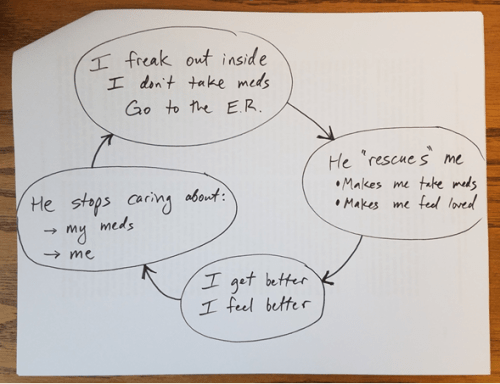
During the next appointment, with her boyfriend in the room, we explored what keeps them together and what pushes them apart. With amazing courage, she vulnerably declared her belief that she couldn’t stop being hospitalized because if she did he might leave her. We drew out their cycle. This is the actual paper we used:
 

paperchartfelix

Some people have been known to say things like, “I’ll kill myself if you break up with me” as an attempt to keep their relationship intact. She didn’t have to kill herself. Her uncontrolled diabetes was doing that for her. She simply needed to allow herself to be sick and he would rush in like Superman to save the day. He would manage her meds on her behalf to rescue her from this villainous disease that she appeared to have no control over. I remember when he first grasped what was going on. He turned to her and asked, “Is this true?” She sheepishly nodded that it was, to which he responded by abruptly leaving the room unable to look her in the eye. Thankfully he was willing to reenter, re-engage, forgive, and begin to work through it with her.

This cycle had been reiterating for many months. I went back through her medical records at both of the hospitals where my residents had treated her and mapped out a timeline of her hospitalizations.

FelixChart.png

Notice the drastic stop in blue and green lines (admissions to both hospitals). Why did they so drastically stop? Had we finally found the correct medication and dosage for her? The red lines are the family therapy appointments I had with her, and the purple ones are the outpatient follow-ups she had with our residents. She had traditionally no-showed most of her outpatient appointments because, I suppose, they weren’t medical crises where she was getting her emotional attachment needs met.

Continue reading

Inspiring, Career Informing, and Irreplaceable

Isabel Chen_F4TScholar2017

Isabel Chen, MD, MPH

Inspiring, career informing, and irreplaceable—these words barely capture the rich and humbling experience of serving in STFM leadership. Taking on the dual role of Resident Representative and Graduate Medical Education Committee member gave me the insight and voice to advance the breadth and impact of our specialty and I am deeply appreciative of the opportunity.

When I started my term, I felt welcomed wholeheartedly by the board and the committee. I found like-minded mentors and role models committed to advancing the training of this country’s primary care workforce so that it serves our trainees, our patients, and our communities at large. These leaders and change agents embodied the best of family medicine and it was an honor to join their company.

This past year was a well-rounded experience for leadership development. Committee work included creating tangible deliverables to STFM members, like our Residency Faculty Fundamentals Certificate Program, and participating in research projects and conference presentations. Serving on the board challenged and strengthened my strategic and organizational skills. I strongly recommend the experience to any trainees passionate about the recruitment, training, and future of our workforce and our impact on this country’s health and wellness!

While I am already mourning the end of my tenure, I think about how deeply STFM has shaped my career path and I look forward to a long career as an active STFM member!

Thank you to all in the STFM family for making this an unforgettable year.

The Two-Way Patient-Doctor Relationship and Physician Resilience

tenegraj_0005web

Johnny Tenegra, MD

So much of 21st century medicine can seem dehumanizing. Whether it is handling prior authorizations by insurances, signing hundreds of orders from pharmacies, or even spending hours in front of a computer screen clicking checkboxes on your electronic medical records, I think to myself that this is not why I entered medicine. As much as every day seems to come to routine, we can’t forget about the memorable moments that come with those special doctor-patient relationship encounters. I spent some time reflecting on my work in academic medicine and realized there have been many times that my patients have helped me be resilient.

Sometimes my patients have great suggestions. I had just finished precepting my last patient, but the clinic was supposed to be finished a half hour ago. I had had a busy afternoon, multitasking, handling phone messages, nursing issues, and even interviewing a resident applicant when I received a message about a patient needing some lab results (thank goodness they were normal!), and I had to call her with a message. I apologized that it was a busy week and for the length of time it took to respond to her, and she detected that I was tired. Realizing it was a late night, my patient then said, “Go home and get some dinner with your wife. I’ll be okay.”

Sometimes my patients are my coaches. Several months later, a couple of my patients noted I was running behind, and I sat down to thank them for being patient with me that day. They told me that I was a sweetheart for not making them feel rushed and that they appreciated my listening to their thoughts and suggestions. Feeling a boost of enthusiasm to get through the rest of my clinic, I gave them a couple hugs for the extra pat on the back.

Continue reading