Category Archives: Family Medicine Stories

Family-Centered Integrated Care

This is is part of the Pecha Kucha: A Special Families and Health Blog Series.

Family systems theory is the foundation upon which family-centered care is built. The following patient story illustrates two aspects of this theory. Although Erica is not her real name, her story is real, and she has given permission to share it to help demonstrate the value of family-centered integrated care.
DanFelixPhotoGrn

Dan Felix, PhD, LMFT

Erica’s type 1 diabetes had been managed pretty well since she was diagnosed at age 6, but now at 19 she was being admitted to the hospital four or five times a month in diabetic ketoacidosis. Although Erica is not her real name, her story is real, and her story demonstrates the value of integrated care. More importantly, it demonstrates the value of family-centered integrated care.

Erica’s physicians—the family medicine residents who I teach—provided appropriate medical treatment each time she was hospitalized. They then sent her home only to see her back the following week with higher levels of blood sugar. “Why don’t you just take your medication?” was answered only by a gentle shrug of her hospital gown-covered shoulders. I was invited into the case with “Dr Felix, fix her. She’s not right in the head. She claims she doesn’t want to die but she sure is acting like it.” So I chatted with her at the bedside a couple of times, which was enough to convince her to come to see me in the clinic between her hospitalizations.    

At first, we didn’t discuss her diabetes. Instead, I found out that she has been with her boyfriend for several months, which was a big deal to her. Relationships, I discovered, had never come easy for her, especially since childhood during which she endured abuses and betrayals.

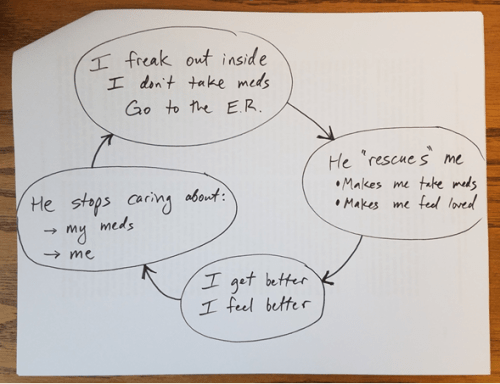
During the next appointment, with her boyfriend in the room, we explored what keeps them together and what pushes them apart. With amazing courage, she vulnerably declared her belief that she couldn’t stop being hospitalized because if she did he might leave her. We drew out their cycle. This is the actual paper we used:
 

paperchartfelix

Some people have been known to say things like, “I’ll kill myself if you break up with me” as an attempt to keep their relationship intact. She didn’t have to kill herself. Her uncontrolled diabetes was doing that for her. She simply needed to allow herself to be sick and he would rush in like Superman to save the day. He would manage her meds on her behalf to rescue her from this villainous disease that she appeared to have no control over. I remember when he first grasped what was going on. He turned to her and asked, “Is this true?” She sheepishly nodded that it was, to which he responded by abruptly leaving the room unable to look her in the eye. Thankfully he was willing to reenter, re-engage, forgive, and begin to work through it with her.

This cycle had been reiterating for many months. I went back through her medical records at both of the hospitals where my residents had treated her and mapped out a timeline of her hospitalizations.

FelixChart.png

Notice the drastic stop in blue and green lines (admissions to both hospitals). Why did they so drastically stop? Had we finally found the correct medication and dosage for her? The red lines are the family therapy appointments I had with her, and the purple ones are the outpatient follow-ups she had with our residents. She had traditionally no-showed most of her outpatient appointments because, I suppose, they weren’t medical crises where she was getting her emotional attachment needs met.

Continue reading

The Moment I Became More Human

Rebekah Rollston

Rebekah Rollston, MD, MPH

It was the first day of my rural primary care health fair week, and my second patient of the day taught me a lesson that will continue to affect my practice of medicine for the duration of my career.

Within 1 minute of entering the patient room, by myself, I learned that my 48-year-old male patient was an ex-convict, released from prison about 8 months ago. This was not the first time he had been in prison… he has been in and out of jail and prison since the age of 15. Within these first few moments, I became fearful for my safety, and I desperately wanted to exit the room. Fortunately, I held myself in my chair and continued to listen to my patient, who has often been regarded as not worthy of respect by society and within the health care system.

He talked to me about his health concerns, countless suicide attempts, incarcerations, reasons for incarcerations, and his current living conditions. I was in awe of his willingness to so freely talk with me about such sensitive subjects, and I was devastated by much of the history he provided. I listened as he proudly told me about the tent he lives in behind Target and was humbled by his pride that his tent area is the cleanest in his tent community. I listened as my patient described various suicide attempts and was saddened by the story of his Coumadin overdose suicide attempt (with the hope that it would burst every blood vessel in his body and kill him). I was honored to be the provider whom he so proudly told the only illicit drug he sometimes uses is marijuana. He was proud to state that he quit abusing prescription pain medications, alcohol, and tobacco. I talked with my patient about impulse control, mental health resources, and employment opportunities. My patient presented for health clearance for his applications for employment.

However, my encounter with him enriched my education and provided me with the first opportunity to see the “human behind the bars.” My patient is a man struggling with severe mental health disease and nearly constant problems with the law. Despite this, he is a human, and I was honored to be the provider for whom he let this shine through. I learned early on that Wednesday morning the degree to which genuineness and respect can impact patient care, impact the patient on a very personal level, and can change the life of a (future) physician. I discovered in these moments my calling to family medicine, to provide holistic health care to my fellow humans.

Humanism is a large part of the art of family medicine, and patients are, first and foremost, human beings. May I always practice the words of Maimonides: “The physician should not treat the disease but the patient who is suffering from it.”Namasté.


Believing in Our Stories and in Our Field

Megan M Chock, MD, MPH

Megan M Chock, MD, MPH

Mariana’s commitment to her community, love of learning, and sincere support inspired me to become a family physician. This blog post is my way of thanking her and showing the influence she’s had on me and my journey and goals in family medicine.

It was an early fall evening in Rochester, Minnesota, and I was trying to put on my newest possession, a big black down-filled coat which made me feel twice as wide and five times as clumsy. I stumbled into the workroom of our free smoking cessation clinic at the local Salvation Army, shrugging the glorified sleeping bag over my shoulders. It was 2010 and I was in my first year of medical school, still trying to figure out how to layer against the cold.

“Hey, are you from Hawaii?”

I turned around, almost knocking over the objects behind me, and saw a smiling, brown-eyed, brown-haired young woman, maybe a few years older than me. “Um–yeah…?”

“Hi, I’m Mariana!”

This was my introduction to Mariana Cook-Huynh, one of the most influential people in my journey to family medicine.

Continue reading